Rocks and minerals form through natural geological processes involving crystallization, sedimentation, metamorphism, and chemical precipitation under varying temperature and pressure conditions.
The rock cycle is a continuous process in which rocks are formed, broken down, and reformed. Igneous rocks can be weathered into sediments that form sedimentary rocks, which can then be transformed into metamorphic rocks under heat and pressure. Metamorphic rocks may melt into magma, completing the cycle. This dynamic system recycles Earth’s materials and explains the diversity of rock types and mineral compositions observed on the planet.
Gemstones are categorized based on their crystal structure, specific gravity, refractive index, and other optical properties. The physical property of “hardness” is defined by the irregular Mohs scale of mineral hardness.
The Mohs scale was developed in 1812 by German mineralogist Friedrich Mohs, and is used to determine the hardness of rocks and minerals by testing their ability to scratch one another or be scratched by other substances. It is an ordinal scale, meaning it ranks minerals in order of hardness but does not measure the exact difference in hardness between them. The scale is widely used in geology, gemology, and mineral identification because it is simple, portable, and requires no specialized equipment.
Hardness on the Mohs scale is determined by scratching a mineral with a reference material. If a mineral can scratch another, it is harder; if it is scratched, it is softer. For example, quartz (7) can scratch feldspar (6) but not topaz (8). The scale ranges from:
- Talc – very soft and easily scratched by a fingernail
- Gypsum
- Calcite
- Fluorite
- Apatite
- Orthoclase (feldspar)
- Quartz
- Topaz
- Corundum
- Diamond – the hardest naturally occurring mineral
Common objects can also be used for field testing:
- Fingernail (~2.5)
- Copper penny (~3.5)
- Steel nail (~6.5)
- Knife/glass plate (~5.5)
Some other interesting terms to know when dealing with rocks and minerals;
Lapidary is the practice of shaping stone, minerals, or gemstones into decorative items such as cabochons, engraved gems (including cameos), and faceted designs. A person who practices lapidary techniques of cutting, grinding, and polishing is known as a lapidary artist or lapidarist.
Chatoyancy is an optical reflectance effect seen in certain gemstones. Historically, the term has applied specifically to gems; in woods and other materials the effect is more broadly known as figure or iridescence.
Coined from the French œil de chat, meaning cat’s eye, the chatoyant effect is typically characterized by one or more well-defined bands of reflected light which appear to glide across a gem’s surface as the object is moved, or when the observer moves while viewing it.
Chatoyancy is caused by the presence of fibrous structures within the material or by fibrous inclusions and cavities in which the effect is caused by the presence of titanium dioxide, which aligns perpendicularly to produce the effect.
Gem species known for this phenomenon include quartz, chrysoberyl, beryl, charoite, tourmaline, labradorite, selenite, feldspar, apatite, moonstone, thomsonite and scapolite amongst others. Chatoyancy is not limited to gemstones but can also be found in wood and carbon fiber. Synthetically made gemstones with optical fibers can also have chatoyancy and are available in a variety of vibrant colors.
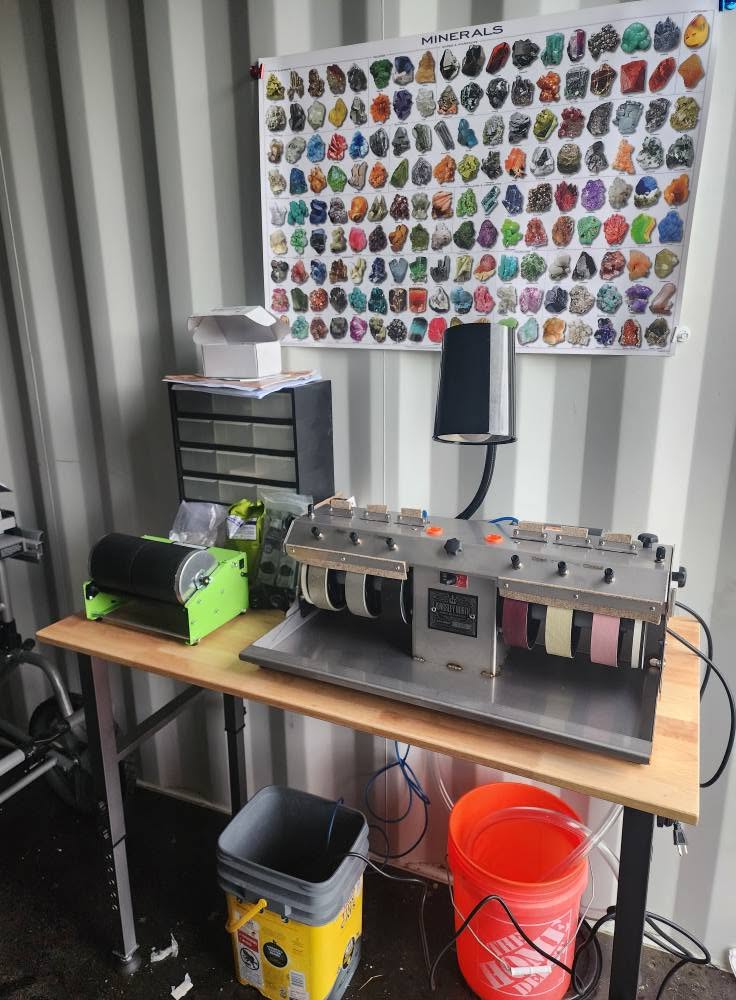
There are three broad categories of lapidary arts: tumbling, cabochon cutting, and faceting.
Stone tumbling is a hobby and lapidary technique that smooths and polishes rough stones using a rotating barrel filled with rocks, water, and abrasive grit. The process mimics natural erosion but accelerates it to take weeks instead of years. Tumbling is ideal for small stones and batches, producing uniform results with minimal manual effort. Patience is key! A full tumble from rough rock to polished gem can take 3–5 weeks or more.
Stone tumbling is both a creative and educational hobby, offering stress relief, insight into geology, and the satisfaction of producing unique polished stones for jewelry or decoration. Rotary or vibratory tumblers are commonly used. Rotary tumblers rotate a barrel slowly, allowing rocks to rub against each other and the grit. For best results, choose stones with a Mohs hardness of 5–7 and roughly 3/8″ to 1 1/2″ in size. Silicon carbide is a standard abrasive grit for shaping and smoothing stones. Polishing Compounds include aluminum oxide, tin oxide, or cerium oxide and are used for the final high-gloss finish. Water is also necessary as it acts as a lubricant to reduce friction and prevent damage.
Cutting of harder stones is done with a diamond-edged saw. For softer materials, a medium other than diamond can be used, such as silicon carbide, garnet, emery, or corundum. Diamond cutting requires the use of diamond tools because of the extreme hardness of diamonds. The cutting, grinding, and polishing operations are usually lubricated with water, oil, or other liquids. The actual shaping and polishing of a gemstone is usually a grinding or sanding process.
Faceting requires equipment allowing for very precise adjustment of angle and location around the gemstone for facet-placement, a process sometimes referred to as indexing. The design may be computer-generated or left up to the skill and expertise of the individual cutting the gemstone. During the process of grinding, faceting, and lapping, the gemstone is often affixed to a dipstick made of wood, brass or steel, with a specialized thermal adhesive. The dopstick can be hand-held or inserted into the indexing equipment for more precise faceting.
Cabochons are smooth-shaped gemstones without facets but are shaped and polished in much the same way. They are usually left up to the skill and expertise of the individual cutting the gemstone and their equipment.
Most modern lapidary work is done using motorized equipment. Polishing is done with resin- or metal-bonded emery, silicon carbide (carborundum), aluminum oxide (corundum), or diamond dust in successively decreasing particle sizes until a polish is achieved. In older systems, the grinding and polishing powders were applied separately to the grinding or buffing wheel. Often, the final polish will use a different medium such as tin oxide or cerium(IV) oxide. The initial shaping and facet placement may be done using grits of 220, 600, and/or 1200. The polishing step, however, requires grits of a much higher grade, such as 8,000, 14,000, 50,000 and even 100,000.
Safety equipment is important! Goggles, apron, and possibly a respirator as well as good ventilation is a must. Some stones contain hazards, even radio-active materials that can seriously harm you when grinding on them.
There are lapidary shops and clubs throughout the world. In the United States, there are over 392 gem and mineral societies across 50 states/regions. Most welcome new members at any skill level — meetings, field trips, lapidary workshops, and annual shows. If you are interested, I think it’s a lot of fun! I caution you, once you start, you probably won’t be able to pass a pile of rocks without at least looking to see if there’s any you would like to play with.
Click here to return to home page

